Bouncy Castle Generate Key Pair
According to Wikipedia the RSA key pair is generated as follows: Choose two Stack Exchange Network Stack Exchange network consists of 175 Q&A communities including Stack Overflow, the largest, most trusted online community for developers to learn, share their knowledge, and build their careers. In fact the Java version was the primary version for the Bouncy Castle library and the C# version is a port of it. It was easy to browse the architecture and class hierarchy of the library in Visual Studio’s Object Browser. In no time was I able to write the following lines to generate a RSA key-pair using the Bouncy Castle library. Key pair generation can be done using explicitly created parameters or b= y retrieving a named curve from a lookup table. From Explicit Parameters. An org.bouncycastle.jce.ECParameterSpec is required to construct an elli= ptic curve key. The long way of creating one of these is to create the ECPa= rameterSpec object from a Bouncy Castle ECCurve object and an associated ba= se.
- Bouncy Castle Generate Key Pair C#
- Bouncy Castle Generate Key Pair 1
- Bouncy Castle Generate Ecc Key Pair
- Bouncy Castle Generate Key Pair For Sale
| //Generate a self signed X509 certificate with Bouncy Castle. |
| // StringBuilder sb = new StringBuilder(); |
| // |
| // for (int i = 0; i < pub.length; ++i) |
| // { |
| // sb.append(Integer.toHexString(0x0100 + (pub[i] & 0x00FF)).substring(1)); |
| // } |
| // |
| // System.out.println(sb); |
| // sb.setLength(0); |
| // |
| // for (int i = 0; i < pri.length; ++i) |
| // { |
| // sb.append(Integer.toHexString(0x0100 + (pri[i] & 0x00FF)).substring(1)); |
| // } |
| // |
| // byte[] enc = new PKCS8Generator(privateKey).generate().getContent(); |
| // |
| // System.out.println(new String(Base64.encodeBase64(enc))); |
| // |
| //// new JcaPKCS8Generator(privateKey, new Output) |
| // |
| // Cipher cipher = SecurityUtils.getCipher('RSA'); |
| // cipher.init(Cipher.DECRYPT_MODE, privateKey); |
| // byte[] doFinal = cipher.doFinal(pub); |
| // System.out.println(new String(doFinal)); |
| // |
| // System.out.println(sb); |
| /** |
| * Generate a self signed X509 certificate with Bouncy Castle. |
| */ |
| staticvoid generateSelfSignedX509Certificate() throws Exception { |
| // yesterday |
| Date validityBeginDate =newDate(System.currentTimeMillis() -24*60*60*1000); |
| // in 2 years |
| Date validityEndDate =newDate(System.currentTimeMillis() +2*365*24*60*60*1000); |
| // GENERATE THE PUBLIC/PRIVATE RSA KEY PAIR |
| KeyPairGenerator keyPairGenerator =KeyPairGenerator.getInstance('RSA', 'BC'); |
| keyPairGenerator.initialize(1024, newSecureRandom()); |
| java.security.KeyPair keyPair = keyPairGenerator.generateKeyPair(); |
| // GENERATE THE X509 CERTIFICATE |
| X509V1CertificateGenerator certGen =newX509V1CertificateGenerator(); |
| X500Principal dnName =newX500Principal('CN=John Doe'); |
| certGen.setSerialNumber(BigInteger.valueOf(System.currentTimeMillis())); |
| certGen.setSubjectDN(dnName); |
| certGen.setIssuerDN(dnName); // use the same |
| certGen.setNotBefore(validityBeginDate); |
| certGen.setNotAfter(validityEndDate); |
| certGen.setPublicKey(keyPair.getPublic()); |
| certGen.setSignatureAlgorithm('SHA256WithRSAEncryption'); |
| X509Certificate cert = certGen.generate(keyPair.getPrivate(), 'BC'); |
| // DUMP CERTIFICATE AND KEY PAIR |
| System.out.println(Strings.repeat('=', 80)); |
| System.out.println('CERTIFICATE TO_STRING'); |
| System.out.println(Strings.repeat('=', 80)); |
| System.out.println(); |
| System.out.println(cert); |
| System.out.println(); |
| System.out.println(Strings.repeat('=', 80)); |
| System.out.println('CERTIFICATE PEM (to store in a cert-johndoe.pem file)'); |
| System.out.println(Strings.repeat('=', 80)); |
| System.out.println(); |
| PEMWriter pemWriter =newPEMWriter(newPrintWriter(System.out)); |
| pemWriter.writeObject(cert); |
| pemWriter.flush(); |
| System.out.println(); |
| System.out.println(Strings.repeat('=', 80)); |
| System.out.println('PRIVATE KEY PEM (to store in a priv-johndoe.pem file)'); |
| System.out.println(Strings.repeat('=', 80)); |
| System.out.println(); |
| pemWriter.writeObject(keyPair.getPrivate()); |
| pemWriter.flush(); |
| System.out.println(); |
| } |
It’s common knowledge today that a blockchain is a form of a distributed ledger that holds transactions. These transactions are collected in a block and added to the ledger with a reference to the previous block by means of hashes so that a block, once added, can no longer be changed. Well, in theory, a block could change, but given the computing power necessary to calculate a hash for a block and the fact that blockchain is distributed it’s extremely difficult. You would need to have 51% of the computing power to do so (https://learncryptography.com/cryptocurrency/51-attack).
This process of calculating a hash for a block is one part in keeping the blockchain trusted. However, what is stopping users from submitting transactions on funds that they don’t actually own? How is it, that I cannot simply publish a transaction that says “transfer 1000 of this cryptocurrency to someone else”.
To understand what’s stopping us from doing so, we need to look at a second part of blockchain technology: public/private key pairs and using them for signatures.
We will be using C# code and .NET Core to work our way through this concept.
Public/private key pair
Asymmetrical cryptography is a technique that uses pairs of keys:
- A public key, visible to anyone.
- A private key, only known to the owner.
The private key is essentially a randomly generated number. The public key can be derived from that public key using what’s called Elliptic Curve Cryptography. We can use ECC for encryption, digital signatures, pseudo-random generators and other tasks. Bitcoin uses a specific elliptic curve called secp256k1 over the finite (prime) field of (2²⁵⁶-2³²-2⁹-2⁸-2⁷-2⁶-2⁴-1) number of elements, using the generator point (on the curve) G=(x, y) where (in hexadecimal):
x=79be667ef9dcbbac55a06295ce870b07029bfcdb2dce28d959f2815b16f81798
y=483ada7726a3c4655da4fbfc0e1108a8fd17b448a68554199c47d08ffb10d4b8
Don’t worry, we will not dive any further into the mathematical details of these ECC algorithms. If you want to know more, check out this article: https://eng.paxos.com/blockchain-101-elliptic-curve-cryptography
Just click the free Serial Key Generator download button at the top left of the page. Clicking this link will start the installer to download Serial Key Generator free for Windows. Will this Serial Key Generator download work on Windows? The free Serial Key Generator download for PC works on most current Windows operating systems. Windows 8.1 Product Key Generator 2020 Cracked Windows 8.1 Product Key Generator is probably the latest update for Window 8 users.It is the best OS in case you want far more features in the operating system of yours. Windows 8, 8.1 product key generator 100% Working. Windows 8.1 Product Key Generator is a useful and reliable program that will make the Operating system Genuine, as well as improves system efficiency and performance. One of the best points about this program is that there are many versions some version does not support a particular product key. Windows 8 serial key generator free download. Jan 10, 2020 Windows 8 Product Key Generator Full Crack Free 2020 Download. Windows 8 Product Key is Microsoft a computer operating system that has been produced by Microsoft as a part of their Windows NT family of operating systems. The operating system was released on August 1, 2012.
In simple code, this is what we do to get the public key from a (random) private key:
The method GetPublicKeyFromPrivateKey looks like this:
The classes CurveFp and Point can be found in the Github repository for this article: https://github.com/sander-/working-with-digital-signatures
If you run this code, you will get following output:
Obviously, having 123456789 as a private key is not particularly safe. But from the public key, there is no way to derive the value of the private key.
Signatures
The process of signing a message entails that you generate a hash that is based on your private key. As you know, hashing is a one-way process, so there’s no way to derive the private key from this hash. However, it is possible to verify whether this hash is accurate if you have the public key of the signer. A digital signature scheme typically consists of 3 algorithms:
- A key generation algorithm that selects a private key uniformly at random from a set of possible private keys. The algorithm outputs the private key and a corresponding public key.
- A signing algorithm that, given a message and a private key, produces a signature.
- A signature verifying algorithm that, given the message, public key and signature, either accepts or rejects the message’s claim to authenticity.
In blockchain, the signature algorithm is the Elliptic Curve Digital Signature Algorithm or ECDSA (https://en.wikipedia.org/wiki/Elliptic_Curve_Digital_Signature_Algorithm). We are not diving into the mathematics of this algorithm. We are, however, going to borrow functions from the BouncyCastle framework (https://www.bouncycastle.org/) to work with ECDSA.
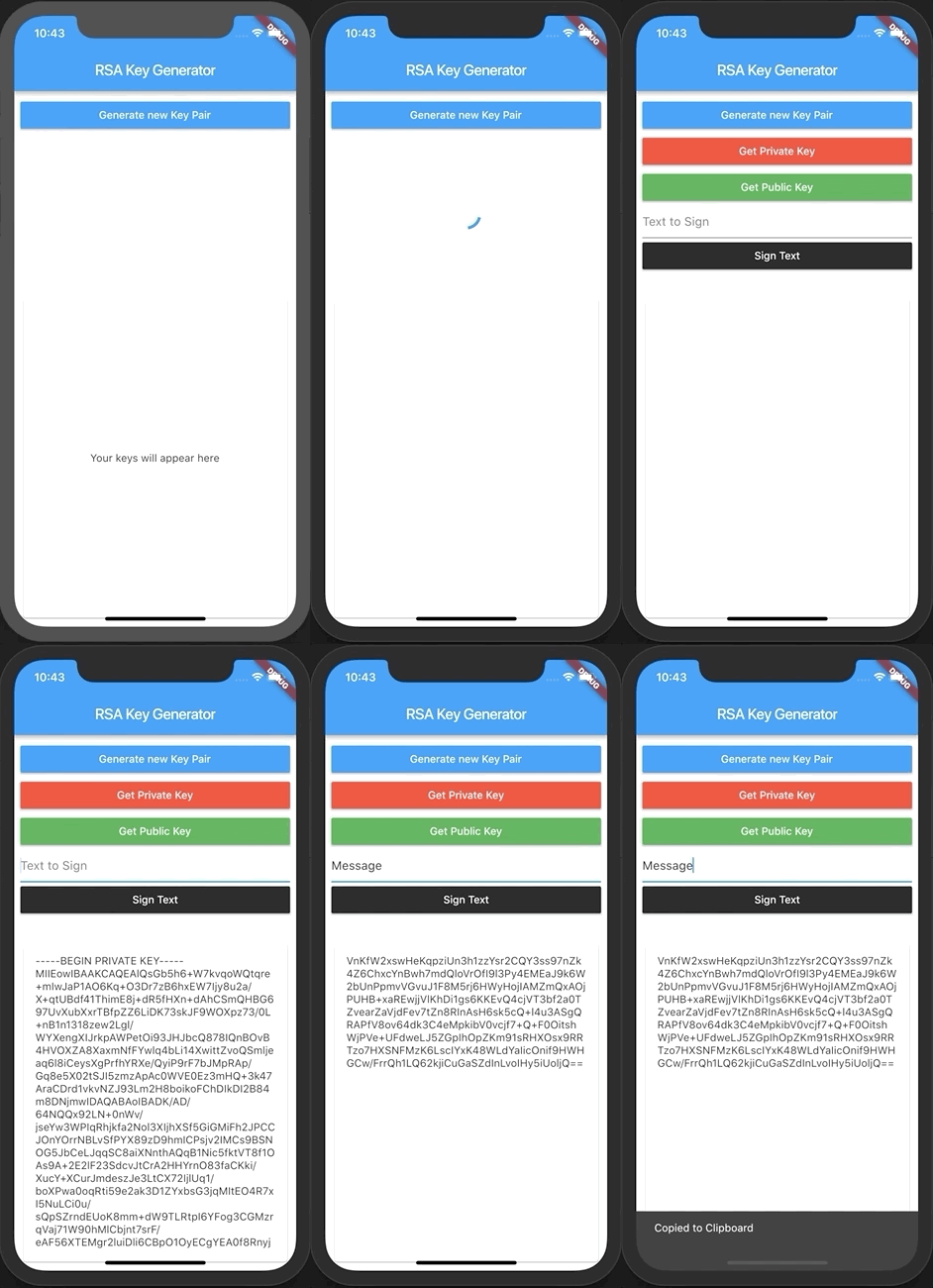
The steps to create a signature for a message are simple.
- Write the message to be signed.
- Create a public/private key pair; to generate the public key from the private key we use the secp256k1 algorithm from before.
- Generate the signature for the message using a signer object.
Strictly speaking, to sign a message we only need a private key. However, signing a message and not giving anyone the public key to verify the signature is pretty pointless.
In code, that reads as follows.
Let’s first look at our new method for generating a public key.
For the sake of readability, the return value of the method is base58 encoded (https://en.wikipedia.org/wiki/Base58).
If we call this method we get our public key, based on the private key we gave as input. So, our public/private key pair contains these values respectively:
The method GetSignature is this.
Bouncy Castle Generate Key Pair C#
The outcome of this method is again base58 encoded to make it easier to read.
We can pass this message signature to someone else. The other party will obviously not have the private key to recreate that signature. But we can also publish the public key and thereby allow the other party to do two things.
- The other party can verify that the message was signed by the keeper of the private key that belongs to or pairs with the public key.
- The other party can also verify that the message was not changed by someone else that didn’t have this private key.
Either a change in the message or in the public key would immediately be recognized as the signature would no longer match. Only the original creator of the message together with his private key can make it so the signature is valid.
To verify the signature, we use this code.
As you can see, nowhere do we specify the private key. The BouncyCastle framework does most if not all of the heavy lifting here in providing a signer object that uses ECDSA.
Transactions in the blockchain
The fact that we can have messages from a known source and that these messages cannot be altered by a third party is essential to transactions in a blockchain. Instead of an unstructured message, transactions have a clear structure. This structure looks something like this:
The From and To properties of the transaction are not simple addresses. They are public keys that help verify the sender and the content of the transaction. The transaction and its signature can be created like this.
Following this code, you can see that the message is signed by the owner of the private key that pairs with the public key. By verifying the signature, you can prove that:
- The creator of the transaction is the holder of the private key belonging to the sender/creator of the transaction.
- The receiver is the original intended receiver.
- The amount has not been altered.
Changing any of the parameters (FromPublicKey, ToPublicKey or Amount) would invalidate the signature and therefore make the entire transaction invalid. Verifying the transaction is simple.
Bouncy Castle Generate Key Pair 1
In summary
Bouncy Castle Generate Ecc Key Pair
Signing is a good way to know something is being done by the correct person. This means we can trust that someone is actually doing what they say they are. In the real world signatures can be faked. The digital ones cannot. Digital signatures act like electronic “fingerprints.” In the form of a coded message, the digital signature securely associates a signer with a message in a recorded transaction. If you want to know person A sent something, make them sign it before moving forward. If there’s any dispute, check the signature. This is a vital part of the blockchain.
Bouncy Castle Generate Key Pair For Sale
The source code for this post can be found at: https://github.com/sander-/working-with-digital-signatures.
Bulletstorm cd key generator download. Halo 2 GFW-Live Key GeneratorWhat is this?-To play Halo 2 multiplayer online, a product key is required to registergames on your gfwl profile, you have to buy a product key in order to playonline.