Part 2 Pairing Method And Key Generation
∟Private key and Public Key Pair Generation
This chapter provides tutorial notes and example codes on private key and public key pair generation. Topics include public key encryption algorithms, RSA, DSA and DiffieHellman; private key and public key pair generation class and sample program; RSA, DSA, and DiffieHellman key pair samples.
Conclusion:
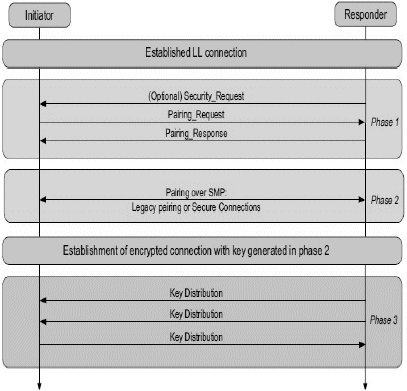
Key Management: Part 2 – Best Practices for Key Management Organizations. Elaine Barker. 6.2.3 Key Generation and/or Certificate Issuance. Asymmetric key algorithms (often called public key algorithms) use a pair of keys (i.e., a key pair): a public key and a private key that are mathematically related to each other. In the case of. Dec 14, 2016 Part 4 explores the pairing process used to establish an environment for the secure transmission of data. Devices before completion of authentication and generation of the final security key.
- JDK supports 3 algorithms to generate private and public pairs: RSA, DSA, and DiffieHellman.
- JDK allows you to store private keys in files with PKCS#8 encoded format.
- JDK allows you to store public keys in files with X.509 encoded format.
Sample programs listed in this chapter have been tested with JDK 12.
Question: Key pairs are used to encrypt and decrypt data. But how to encrypt and decrypt data? Which classes and methods to use?
Table of Contents
About This Book
Cryptography Terminology
Cryptography Basic Concepts
Introduction to AES (Advanced Encryption Standard)
Introduction to DES Algorithm
DES Algorithm - Illustrated with Java Programs
DES Algorithm Java Implementation
DES Algorithm - Java Implementation in JDK JCE
DES Encryption Operation Modes
DES in Stream Cipher Modes
PHP Implementation of DES - mcrypt
Blowfish - 8-Byte Block Cipher
Secret Key Generation and Management
Cipher - Secret Key Encryption and Decryption
Introduction of RSA Algorithm
RSA Implementation using java.math.BigInteger Class
Introduction of DSA (Digital Signature Algorithm)
Java Default Implementation of DSA
►Private key and Public Key Pair Generation
PKCS#8/X.509 Private/Public Encoding Standards Windows 7 professional 64 bit activation key.
Cipher - Public Key Encryption and Decryption
MD5 Mesasge Digest Algorithm
SHA1 Mesasge Digest Algorithm
To sign an assembly with a strong name, you must have a public/private key pair. This public and private cryptographic key pair is used during compilation to create a strong-named assembly. You can create a key pair using the Strong Name tool (Sn.exe). Windows 10 generate public key. To generate the public/private key pair, enter this in the Command Prompt: ssh-keygen At the first prompt, “Enter file in which to save the key,” press Enter to save it in the default location.
OpenSSL Introduction and Installation
OpenSSL Generating and Managing RSA Keys
OpenSSL Managing Certificates
OpenSSL Generating and Signing CSR
OpenSSL Validating Certificate Path
'keytool' and 'keystore' from JDK
'OpenSSL' Signing CSR Generated by 'keytool'
Migrating Keys from 'keystore' to 'OpenSSL' Key Files
Certificate X.509 Standard and DER/PEM Formats
Migrating Keys from 'OpenSSL' Key Files to 'keystore'
Using Certificates in IE
Using Certificates in Google Chrome
Using Certificates in Firefox
Outdated Tutorials
References
Part 2 Pairing Method And Key Generation 2
Full Version in PDF/EPUB