Key Issue In Generativity Vs Stagnation
- Erikson's 8 Stages of Development. Middle-Aged Adult: Generativity vs. At middle age, adults need to feel as if they're contributing to the world.
- Sep 29, 2019 This is a key goal of adults in this developmental period. Discuss how Erikson’s stage of psychosocial development of generativity versus stagnation motivates the decisions made by adults during middle adulthood. How do roles like kinkeeper or parental caretaker affect adults’ self-care (e.g., physical, social, and psychological)?
- Generativity Versus Stagnation Example
- Key Issue In Generativity Vs Stagnation Examples
- Erikson Generativity Vs Stagnation
- Generativity Vs Stagnation Examples
- Industry Vs Inferiority
Sep 25, 2019 Erikson believed that the stage of generativity, during which one established a family and career, was the longest of all the stages. Individuals at midlife are primarily concerned with leaving a positive legacy of themselves, and according to Erikson (1950) parenthood is the primary generative type.
Learning Outcomes
- Describe Erikson’s stage of generativity vs. stagnation
- Evaluate Levinson’s notion of the midlife crisis
- Examine key theories on aging, including socio-emotional selectivity theory (SSC) and selection, optimization, and compensation (SOC)
What do you think is the happiest stage of life? What about the saddest stages? Perhaps surprisingly, Blanchflower & Oswald (2008) found that reported levels of unhappiness and depressive symptoms peak in the early 50s for men in the U.S., and interestingly, the late 30s for women. In Western Europe, minimum happiness is reported around the mid 40s for both men and women, albeit with some significant national differences. Stone, Schneider and Bradoch (2017), reported a precipitous drop in perceived stress in men in the U.S. from their early 50s. There is now a view that “older people” (50+) may be “happier” than younger people, despite some cognitive and functional losses. This is often referred to as “the paradox of aging.” Positive attitudes to the continuance of cognitive and behavioral activities, interpersonal engagement, and their vitalizing effect on human neural plasticity, may lead not only to more life, but to an extended period of both self-satisfaction and continued communal engagement. [1]
Erikson’s Theory
As you know by now, Erikson’s theory is based on an idea called epigenesis, meaning that development is progressive and that each individual must pass through the eight different stages of life—all while being influenced by context and environment. Each stage forms the basis for the following stage, and each transition to the next is marked by a crisis which must be resolved. The sense of self, each “season”, was wrested, from and by, that conflict. The ages 40-65 are no different. The individual is still driven to engage productively, but the nurturing of children and income generation assume lesser functional importance. From where will the individual derive their sense of self and self-worth?
Generativity versus Stagnation is Erikson’s characterization of the fundamental conflict of adulthood. It is the seventh conflict of his famous “8 seasons of man” (1950) and negotiating this conflict results in the virtue of care. Generativity is “primarily the concern in establishing and guiding the next generation” (Erikson, 1950 p.267). Generativity is a concern for a generalized other (as well as those close to an individual) and occurs when a person can shift their energy to care for and mentor the next generation. One obvious motive for this generative thinking might be parenthood, but others have suggested intimations of mortality by the self. John Kotre (1984) theorized that generativity is a selfish act, stating that its fundamental task was to outlive the self. He viewed generativity as a form of investment. However, a commitment to a “belief in the species” can be taken in numerous directions, and it is probably correct to say that most modern treatments of generativity treat it as collection of facets or aspects—encompassing creativity, productivity, commitment, interpersonal care, and so on.
On the other side of generativity is stagnation. It is the feeling of lethargy and a lack of enthusiasm and involvement in both individual and communal affairs. It may also denote an underdeveloped sense of self, or some form of overblown narcissism. Erikson sometimes used the word “rejectivity” when referring to severe stagnation
The Stage-Crisis View and the Midlife Crisis
In 1977, Daniel Levinson published an extremely influential article that would be seminal in establishing the idea of a profound crisis which lies at the heart of middle adulthood. The concept of a midlife crisis is so pervasive that over 90% of Americans are familiar with the term, although those who actually report experiencing such a crisis is significantly lower (Wethington, 2000).
Levinson based his findings about a midlife crisis on biographical interviews with a limited sample of 40 men (no women!), and an entirely American sample at that. Despite these severe methodological limitations, his findings proved immensely influential. Levinson (1986) identified five main stages or “seasons” of a man’s life as follows:
- Preadulthood: Ages 0-22 (with 17 – 22 being the Early Adult Transition years)
- Early Adulthood: Ages 17-45 (with 40 – 45 being the Midlife Transition years)
- Middle Adulthood: Ages 40-65 (with 60-65 being the Late Adult Transition years)
- Late Adulthood: Ages 60-85
- Late Late Adulthood: Ages 85+
Figure 1. <add caption> According to Levinson, we go through a midlife crisis. While most people have heard of the midlife crisis, and often associate with sports cars, joining a band, or exploring new relationships, there is very little support for the theory as it was proposed by Levinson.
Levinson’s theory is known as the stage-crisis view. He argued that each stage overlaps, consisting of two distinct phases—a stable phase, and a transitional phase into the following period. The latter phase can involve questioning and change, and Levinson believed that 40-45 was a period of profound change, which could only culminate in a reappraisal, or perhaps reaffirmation, of goals, commitments and previous choices—a time for taking stock and recalibrating what was important in life. Crucially, Levinson would argue that a much wider range of factors, involving, primarily, work and family, would affect this taking stock – what he had achieved, what he had not; what he thought important, but had brought only a limited satisfaction.
 The Serial for Windows 7 Product Key Generator will confide on the CPU or processor Architecture your personal digital assistant uses. On Basis of CPU Architecture your Operating System will have as a choice Windows 7 prospective 6 small amount product time signature or windows 7 from here to eternity 32 drop in the bucket product key. Nov 24, 2019 Windows 7 Product Key Generator Free for Windows public use after three year of released of windows vista and windows 8.1 is latest version freely for all Windows Activator Loader Fully working Free Download Windows Loader, Activators, Product Keys, Serial Keys, Cracks, KMS Pico, Remove WAT, DAZ, Hazar, and more for Windows XP, Vista, 7, 8, 8.1, 10. Jan 18, 2020 Features of Windows 7 Product Key Generator. The windows 7 product key Generator is among the easy to use softwares. It works on very flexible and convenient principles. The features are as follows; It is not a MUST to be connected to the internet during the installation of windows 7 process. This is even when using the product keys. Mar 09, 2020 Overview of Windows 7 Product Key Generator. Windows 7 is a generally accepted Windows worldwide. It is now widely considered as the Windows OS with the friendliest interface. This makes people have an interest in getting it installed on their laptop. Various kinds of people use it, both for personal works and for business-oriented programs.
In 1996, two years after his death, the study he was conducting with his co-author and wife Judy Levinson, was published on “the seasons of life” as experienced by women. Again, it was a small scale study, with 45 women who were professionals / businesswomen, academics, and homemakers, in equal proportion. The changing place of women in society was reckoned by Levinson to be a profound moment in the social evolution of the human species, however, it had led to a fundamental polarity in the way that women formed and understood their social identity. Levinson referred to this as the “dream.” For men, the “dream” was formed in the age period of 22-28, and largely centered on the occupational role and professional ambitions. Levinson understood the female “dream” as fundamentally split between this work-centered orientation, and the desire/imperative of marriage/family; a polarity which heralded both new opportunities, and fundamental angst.
Levinson found that the men and women he interviewed sometimes had difficulty reconciling the “dream” they held about the future with the reality they currently experienced. “What do I really get from and give to my wife, children, friends, work, community-and self?” a man might ask (Levinson, 1978, p. 192). Tasks of the midlife transition include:
- ending early adulthood;
- reassessing life in the present and making modifications if needed; and
- reconciling “polarities” or contradictions in ones sense of self.
Perhaps early adulthood ends when a person no longer seeks adult status but feels like a full adult in the eyes of others. This “permission” may lead to different choices in life—choices that are made for self-fulfillment instead of social acceptance. While people in their 20s may emphasize how old they are (to gain respect, to be viewed as experienced), by the time people reach their 40s, they tend to emphasize how young they are (few 40 year olds cut each other down for being so young: “You’re only 43? I’m 48!!”).
This new perspective on time brings about a new sense of urgency to life. The person becomes focused more on the present than the future or the past. The person grows impatient at being in the “waiting room of life,” postponing doing the things they have always wanted to do. “If it’s ever going to happen, it better happen now.” A previous focus on the future gives way to an emphasis on the present. Neugarten (1968) notes that in midlife, people no longer think of their lives in terms of how long they have lived. Rather, life is thought of in terms of how many years are left. If an adult is not satisfied at midlife, there is a new sense of urgency to start to make changes now.
Changes may involve ending a relationship or modifying one’s expectations of a partner. These modifications are easier than changing the self (Levinson, 1978). Midlife is a period of transition in which one holds earlier images of the self while forming new ideas about the self of the future. A greater awareness of aging accompanies feelings of youth, and harm that may have been done previously in relationships haunts new dreams of contributing to the well-being of others. These polarities are the quieter struggles that continue after outward signs of “crisis” have gone away.
Levinson characterized midlife as a time of developmental crisis. However, like any body of work, it has been subject to criticism. Firstly, the sample size of the populations on which he based his primary findings is too small. By what right do we generalize findings from interviews with 40 men, and 45 women, however thoughtful and well conducted? Secondly, Chiriboga (1989) could not find any substantial evidence of a midlife crisis, and it might be argued that this, and further failed attempts at replication, indicate a cohort effect. The findings from Levinson’s population indicated a shared historical and cultural situatedness, rather than a cross-cultural universal experienced by all or even most individuals. Midlife is a time of revaluation and change, that may escape precise determination in both time and geographical space, but people do emerge from it, and seem to enjoy a period of contentment, reconciliation and acceptance of self.
Watch It
This video explains research and controversy surrounding the concept of a midlife crisis.
You can view the transcript for “Does Everyone Have a ‘Midlife Crisis’?” here (opens in new window).
Socio-Emotional Selectivity Theory (SST)
It is the inescapable fate of human beings to know that their lives are limited. As people move through life, goals and values tend to shift. What we consider priorities, goals, and aspirations are subject to renegotiation. Attachments to others, current and future, are no different. Time is not the unlimited good as perceived by a child under normal social circumstances; it is very much a valuable commodity, requiring careful consideration in terms of the investment of resources. This has become known in the academic literature as mortality salience.
Mortality salience posits that reminders about death or finitude (at either a conscious or subconscious level), fills us with dread. We seek to deny its reality, but awareness of the increasing nearness of death can have a potent effect on human judgement and behavior. This has become a very important concept in contemporary social science. It is with this understanding that Laura Carstensen developed the theory of socioemotional selectivity theory, or SST. The theory maintains that as time horizons shrink, as they typically do with age, people become increasingly selective, investing greater resources in emotionally meaningful goals and activities. According to the theory, motivational shifts also influence cognitive processing. Aging is associated with a relative preference for positive over negative information. This selective narrowing of social interaction maximizes positive emotional experiences and minimizes emotional risks as individuals become older. They systematically hone their social networks so that available social partners satisfy their emotional needs. The French philosopher Sartre observed that “hell is other people”.An adaptive way of maintaining a positive affect might be to reduce contact with those we know may negatively affect us, and avoid those who might.
SST is a theory which emphasizes a time perspective rather than chronological age. When people perceive their future as open ended, they tend to focus on future-oriented development or knowledge-related goals. When they feel that time is running out, and the opportunity to reap rewards from future-oriented goals’ realization is dwindling, their focus tends to shift towards present-oriented and emotion or pleasure-related goals. Research on this theory often compares age groups (e.g., young adulthood vs. old adulthood), but the shift in goal priorities is a gradual process that begins in early adulthood. Importantly, the theory contends that the cause of these goal shifts is not age itself, i.e., not the passage of time itself, but rather an age-associated shift in time perspective. The theory also focuses on the types of goals that individuals are motivated to achieve. Knowledge-related goals aim at knowledge acquisition, career planning, the development of new social relationships and other endeavors that will pay off in the future. Emotion-related goals are aimed at emotion regulation, the pursuit of emotionally gratifying interactions with social partners, and other pursuits whose benefits which can be realized in the present.
This shift in emphasis, from long term goals to short term emotional satisfaction, may help explain the previously noted “paradox of aging.” That is, that despite noticeable physiological declines, and some notable self-reports of reduced life-satisfaction around this time, post- 50 there seems to be a significant increase in reported subjective well-being. SST does not champion social isolation, which is harmful to human health, but shows that increased selectivity in human relationships, rather than abstinence, leads to more positive affect. Perhaps “midlife crisis and recovery” may be a more apt description of the 40-65 period of the lifespan.
Generativity Versus Stagnation Example
Watch It
Watch Laura Carstensen in this TED talk explain how happiness actually increases with age.
You can view the transcript for “Older people are happier – Laura Carstensen” here (opens in new window).
Figure 2. Italian soccer player Paulo Maldini in 2008, just one year before he retired at age 41. He appeared in an incredible 8 champions league finals during his 25-year career. Defensive players like Maldini tend to have a longer career due to their experience compensating for a decline in pace, while offensive players are generally sought after for their agility and speed.
Selection, Optimization, Compensation (SOC)
Another perspective on aging was identified by German developmental psychologists Paul and Margret Baltes. Their text Successful Aging (1990) marked a seismic shift in moving social science research on aging from largely a deficits-based perspective to a newer understanding based on a holistic view of the life-course itself. The former had tended to focus exclusively on what was lost during the aging process, rather than seeing it as a balance between those losses and gains in areas like the regulation of emotion, experience and wisdom.
The Baltes’ model for successful aging argues that across the lifespan, people face various opportunities or challenges such as, jobs, educational opportunities, and illnesses. According to the SOC model, a person may select particular goals or experiences, or circumstances might impose themselves on them. Either way, the selection process includes shifting or modifying goals based on choice or circumstance in response to those circumstances. The change in direction may occur at the subconscious level. This model emphasizes that setting goals and directing efforts towards a specific purpose is beneficial to healthy aging. Optimization is about making the best use of the resources we have in pursuing goals. Compensation, as its name suggests, is about using alternative strategies in attaining those goals.[2]
The processes of selection, optimization, and compensation can be found throughout the lifespan. As we progress in years, we select areas in which we place resources, hoping that this selection will optimize the resources that we have, and compensate for any defects accruing from physiological or cognitive changes. Previous accounts of aging had understated the degree to which possibilities from which we choose had been eliminated, rather than reduced, or even just changed. As we select areas in which to invest, there is always an opportunity cost. We are masters of our own destiny, and our own individual orientation to the SOC processes will dictate “successful aging.” Rather than seeing aging as a process of progressive disengagement from social and communal roles undertaken by a group, Baltes argued that “successful aging” was a matter of sustained individual engagement, accompanied by a belief in individual self-efficacy and mastery.
The SOC model covers a number of functional domains—motivation, emotion, and cognition. We might become more adept at playing the SOC game as time moves on, as we work to compensate and adjust for changing abilities across the lifespan. For example, a soccer a player at 35 may no longer have the vascular and muscular fitness that they had at 20 but her “reading” of the game might compensate for this decline. She may well be a better player than she was at 20, even with fewer physical resources in a game which ostensibly prioritizes them. The work of Paul and Margaret Baltes was very influential in the formation of a very broad developmental perspective which would coalesce around the central idea of resiliency.[3]
Glossary
- generativity:
- the ability to look beyond self-interest and motivate oneself to care for, and contribute to, the welfare of the next generation
- socioemotional selectivity theory:
- theory associated with the developmentalist Laura Carestensen which posits a shift at this time in the life course, caused by a shift in time horizons. Time left in our lives is now shorter than time previously spent. Consciously, or sub-consciously, this influences a greater unwillingness to “suffer fools gladly” or endure unsatisfactory situations at work or elsewhere. Emotional regulation, and the satisfactions that affords, becomes more important, and demands fulfillment in the present
- selection, optimization, compensation (SOC) theory:
- theory which argues that the declines experienced at this time are not simple or absolute losses. Or, rather, they need not be. Baltes argues that life is a series of adaptations and that the selection of fewer goals, optimizing our personal and social resources to attain them, and then compensating for any loss with the experience of a lifetime, should ameliorate those losses. They do not completely negate them but a positive attitude of engagement can, and does, lead to successful ageing
- stage-crisis view:
- theory associated with Levinson (and Erikson before) that each life stage is characterized by a fundamental conflict(s) which must be resolved before moving on to the next. Each stage has its challenges which are resolved, instigating a period of transition which sets the stage for the next
- stagnation:
- a feeling of a disconnect from wider society experience by those 40-65 who fail to develop the attitude of care associated with generativity
- Blanchflower, D. G., & Oswald, A. J. (2008, April).Is well-being U-shaped over the life cycle? Retrieved from https://www.ncbi.nlm.nih.gov/pubmed/18316146↵
- Stephanie, R., Margie, L., & Elizabeth, R. (2015). Self-Regulatory Strategies in Daily Life: Selection, Optimization, and Compensation and Everyday Memory Problems. International journal of behavioral development, 40(2), 126-136. ↵
- Weiss, L. A., Westerhof, G. J., & Bohlmeijer, E. T. (2016). Can We Increase Psychological Well-Being? The Effects of Interventions on Psychological Well-Being: A Meta-Analysis of Randomized Controlled Trials. PloS one, 11(6), e0158092. doi:10.1371/journal.pone.0158092 ↵
Erikson’s psychosocial stages of development focus on the resolution of different crises to become a successful, complete person.
LEARNING OBJECTIVE
- Summarize Erikson’s stages of psychosocial development
Key Issue In Generativity Vs Stagnation Examples
KEY POINTS
- Erik Erikson (1902–1994) was a stage theorist who took Freud’s controversial psychosexualtheory and modified it into an eight-stage psychosocial theory of development.
- During each of Erikson’s eight development stages, two conflicting ideas must be resolved successfully in order for a person to become a confident, contributing member of society. Failure to master these tasks leads to feelings of inadequacy.
- Erikson’s eight stages of psychosocial development include trust vs. mistrust, autonomy vs. shame/doubt, initiative vs. guilt, industry vs. inferiority, identity vs. role confusion, intimacy vs. isolation, generativity vs. stagnation, and integrity vs. despair.
- Erikson also expanded upon Freud’s stages by discussing the cultural implications of development; certain cultures may need to resolve the stages in different ways based upon their cultural and survival needs.
TERMS
- autonomy: Self-government; freedom to act or function independently.
- psychosocial: Having both psychological and social aspects.
Erik Erikson (1902–1994) was a stage theorist who took Freud’s controversial theory of psychosexual development and modified it as a psychosocial theory. Erikson emphasized that the ego makes positive contributions to development by mastering attitudes, ideas, and skills at each stage of development. This mastery helps children grow into successful, contributing members of society. During each of Erikson’s eight stages, there is a psychological conflict that must be successfully overcome in order for a child to develop into a healthy, well-adjusted adult.
Erik Erikson
Erikson developed his eight stages of psychosocial development based on Freud’s psychosexual theory.
Erikson’s stages of psychosocial development are based on (and expand upon) Freud’s psychosexual theory. Erikson proposed that we are motivated by the need to achieve competence in certain areas of our lives. According to psychosocial theory, we experience eight stages of development over our lifespan, from infancy through late adulthood. At each stage there is a crisis or task that we need to resolve. Successful completion of each developmental task results in a sense of competence and a healthy personality. Failure to master these tasks leads to feelings of inadequacy.
Erikson also added to Freud’s stages by discussing the cultural implications of development; certain cultures may need to resolve the stages in different ways based upon their cultural and survival needs.
Trust vs. Mistrust
From birth to 12 months of age, infants must learn that adults can be trusted. This occurs when adults meet a child’s basic needs for survival. Infants are dependent upon their caregivers, so caregivers who are responsive and sensitive to their infant’s needs help their baby to develop a sense of trust; their baby will see the world as a safe, predictable place. Unresponsive caregivers who do not meet their baby’s needs can engender feelings of anxiety, fear, and mistrust; their baby may see the world as unpredictable. If infants are treated cruelly or their needs are not met appropriately, they will likely grow up with a sense of mistrust for people in the world.
Autonomy vs. Shame/Doubt
As toddlers (ages 1–3 years) begin to explore their world, they learn that they can control their actions and act on their environment to get results. They begin to show clear preferences for certain elements of the environment, such as food, toys, and clothing. A toddler’s main task is to resolve the issue of autonomy vs. shame and doubt by working to establish independence. This is the “me do it” stage. For example, we might observe a budding sense of autonomy in a 2-year-old child who wants to choose her clothes and dress herself. Although her outfits might not be appropriate for the situation, her input in such basic decisions has an effect on her sense of independence. If denied the opportunity to act on her environment, she may begin to doubt her abilities, which could lead to low self-esteem and feelings of shame.
Initiative vs. Guilt
Once children reach the preschool stage (ages 3–6 years), they are capable of initiating activities and asserting control over their world through social interactions and play. According to Erikson, preschool children must resolve the task of initiative vs. guilt.By learning to plan and achieve goals while interacting with others, preschool children can master this task. Initiative, a sense of ambition and responsibility, occurs when parents allow a child to explore within limits and then support the child’s choice. These children will develop self-confidence and feel a sense of purpose. Those who are unsuccessful at this stage—with their initiative misfiring or stifled by over-controlling parents—may develop feelings of guilt.
Industry vs. Inferiority
During the elementary school stage (ages 6–12), children face the task of industry vs. inferiority. Children begin to compare themselves with their peers to see how they measure up. They either develop a sense of pride and accomplishment in their schoolwork, sports, social activities, and family life, or they feel inferior and inadequate because they feel that they don’t measure up. If children do not learn to get along with others or have negative experiences at home or with peers, an inferiority complex might develop into adolescence and adulthood.
Identity vs. Role Confusion
Erikson Generativity Vs Stagnation
In adolescence (ages 12–18), children face the task of identity vs. role confusion. According to Erikson, an adolescent’s main task is developing a sense of self. Adolescents struggle with questions such as “Who am I?” and “What do I want to do with my life?” Along the way, most adolescents try on many different selves to see which ones fit; they explore various roles and ideas, set goals, and attempt to discover their “adult” selves. Adolescents who are successful at this stage have a strong sense of identity and are able to remain true to their beliefs and values in the face of problemsand other people’s perspectives. When adolescents are apathetic, do not make a conscious search for identity, or are pressured to conform to their parents’ ideas for the future, they may develop a weak sense of self and experience role confusion. They will be unsure of their identity and confused about the future. Teenagers who struggle to adopt a positive role will likely struggle to “find” themselves as adults.
Intimacy vs. Isolation
People in early adulthood (20s through early 40s) are concerned with intimacy vs. isolation. After we have developed a sense of self in adolescence, we are ready to share our life with others. However, if other stages have not been successfully resolved, young adults may have trouble developing and maintaining successful relationships with others. Erikson said that we must have a strong sense of self before we can develop successful intimate relationships. Adults who do not develop a positive self-concept in adolescence may experience feelings of loneliness and emotional isolation.
Generativity vs. Stagnation
Generativity Vs Stagnation Examples
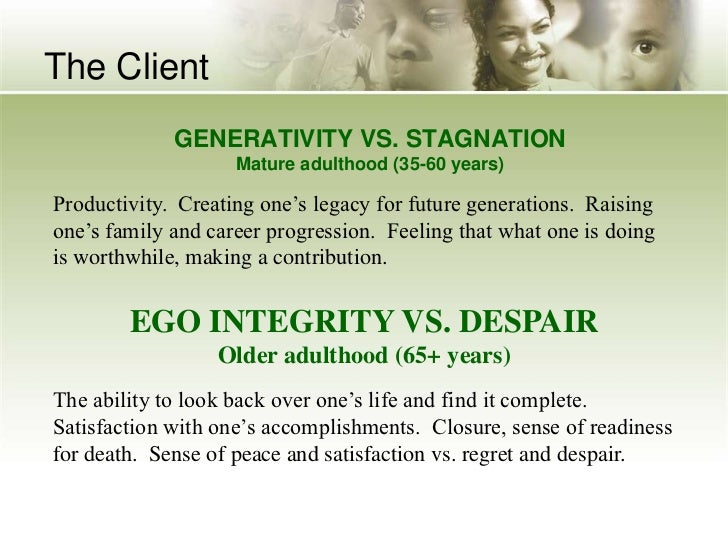
When people reach their 40s, they enter the time known as middle adulthood, which extends to the mid-60s. The social task of middle adulthood is generativity vs. stagnation. Generativity involves finding your life’s work and contributing to the development of others through activities such as volunteering, mentoring, and raising children. During this stage, middle-aged adults begin contributing to the next generation, often through childbirth and caring for others; they also engage in meaningful and productive work which contributes positively to society. Those who do not master this task may experience stagnation and feel as though they are not leaving a mark on the world in a meaningful way; they may have little connection with others and little interest in productivity and self-improvement.
Integrity vs. Despair
Industry Vs Inferiority
From the mid-60s to the end of life, we are in the period of development known as late adulthood. Erikson’s task at this stage is called integrity vs. despair. He said that people in late adulthood reflect on their lives and feel either a sense of satisfaction or a sense of failure. People who feel proud of their accomplishments feel a sense of integrity, and they can look back on their lives with few regrets. However, people who are not successful at this stage may feel as if their life has been wasted. They focus on what “would have,” “should have,” and “could have” been. They face the end of their lives with feelings of bitterness, depression, and despair.