Hi, this is Jeff Podlasek with Toad DB2 Development. I'm going to cover some of the key DBA features that are available in Toad for DB2-- for DB2 on z/OS or DB2 on the mainframe. I've got Toad up and running. And I've got a Database Explorer open. And the first thing I want to talk about is the ability to easily generate DDL for any type of object. Every time you select an object on the left-hand side of the database explorer, you will see a script tab on the right-hand side of the Explorer. You can very quickly and easily go there. And it will generate the DDL for that object. You can then right-click if you wanted to and then open up that DDL in an Editor. That's one way of getting the DDL for a given object. Toad has many variations of and ways of getting DDL. That's one. Another would be just to right-click and generate-- select Generate SQL, and then select Creation Script. And this will actually open up a creation script inside a SQL Editor. So that's another way of getting the DDL for a given object. Another way is to use the Extract DDL Wizard. To invoke that, you would right-click and you would select Extract DDL. And up comes the Extract DDL Wizard. This gives you the option. It's a little more powerful than the script tab or just sending the DDL to an Editor because it gives the option of selecting referenced objects and dependent objects. And you could get very granular as to which objects you want to generate with the selected object. But once you hit Build Script, a background task is going to start. And it's going to generate the DDL and then open up a SQL Editor. And you can see now that a SQL Editor has been opened with all the DDL for that object and all its referenced independent objects. I'm Can shut this down. And I'm just going to bring up the Script Map. So rather quickly we can see what type of objects have been generated. So this table has some views, has some indexes, et cetera. So that's the generated script from the Extract DDL Wizard. I'm going to shut this down now. And I'm just going to show you another example. If I jumped over to Databases, one thing that's known is that you could invoke Extract DDL with any type of object. So I picked, let's say, Extract DDL with a database. And from the Wizard, I say, Include Dependents. That's going to bring in and create the DDL for not only the database, but all the tablespaces in that database and then the tables within those tablespaces. So I'm going to click Build Script again and drive it. And I got a background task is executed. You can see that the task is executing in the task bar. And then a script tab will open when that is complete. You can see that a SQL editor session was opened with the script that was generated. Again, I'm going to bring up Script Map and refresh. Now you can see all the statements that were generated. You want to jump to a statement, you just double-click on it in the Script Map. You can see that there's plenty of create table, create tablespace statements that were created because I wanted all the referenced, or the dependent objects, for that database, as I selected in the Extract DDL Wizard. So those are some of the quick and easy ways to generate DDL using Toad for DB2 on z/OS.
Db2 Foreign Key Definition Is Not Showing In Toad Generation 2
Db2 Foreign Key Definition Is Not Showing In Toad Generation Youtube
Hi, this is Jeff Podlasek with Toad DB2 Development. I'm going to cover some of the key DBA features that are available in Toad for DB2-- for DB2 on z/OS or DB2 on the mainframe. I've got Toad up and running. And I've got a Database Explorer open. And the first thing I want to talk about is the ability to easily generate DDL for any type of object. Every time you select an object on the left-hand side of the database explorer, you will see a script tab on the right-hand side of the Explorer. You can very quickly and easily go there. And it will generate the DDL for that object. You can then right-click if you wanted to and then open up that DDL in an Editor. That's one way of getting the DDL for a given object. Toad has many variations of and ways of getting DDL. That's one. Another would be just to right-click and generate-- select Generate SQL, and then select Creation Script. And this will actually open up a creation script inside a SQL Editor. So that's another way of getting the DDL for a given object. Another way is to use the Extract DDL Wizard. To invoke that, you would right-click and you would select Extract DDL. And up comes the Extract DDL Wizard. This gives you the option. It's a little more powerful than the script tab or just sending the DDL to an Editor because it gives the option of selecting referenced objects and dependent objects. And you could get very granular as to which objects you want to generate with the selected object. But once you hit Build Script, a background task is going to start. And it's going to generate the DDL and then open up a SQL Editor. And you can see now that a SQL Editor has been opened with all the DDL for that object and all its referenced independent objects. I'm Can shut this down. And I'm just going to bring up the Script Map. So rather quickly we can see what type of objects have been generated. So this table has some views, has some indexes, et cetera. So that's the generated script from the Extract DDL Wizard. I'm going to shut this down now. And I'm just going to show you another example. If I jumped over to Databases, one thing that's known is that you could invoke Extract DDL with any type of object. So I picked, let's say, Extract DDL with a database. And from the Wizard, I say, Include Dependents. That's going to bring in and create the DDL for not only the database, but all the tablespaces in that database and then the tables within those tablespaces. So I'm going to click Build Script again and drive it. And I got a background task is executed. You can see that the task is executing in the task bar. And then a script tab will open when that is complete. You can see that a SQL editor session was opened with the script that was generated. Again, I'm going to bring up Script Map and refresh. Now you can see all the statements that were generated. You want to jump to a statement, you just double-click on it in the Script Map. You can see that there's plenty of create table, create tablespace statements that were created because I wanted all the referenced, or the dependent objects, for that database, as I selected in the Extract DDL Wizard. So those are some of the quick and easy ways to generate DDL using Toad for DB2 on z/OS.
Db2 Foreign Key Definition Is Not Showing In Toad Generation Lyrics
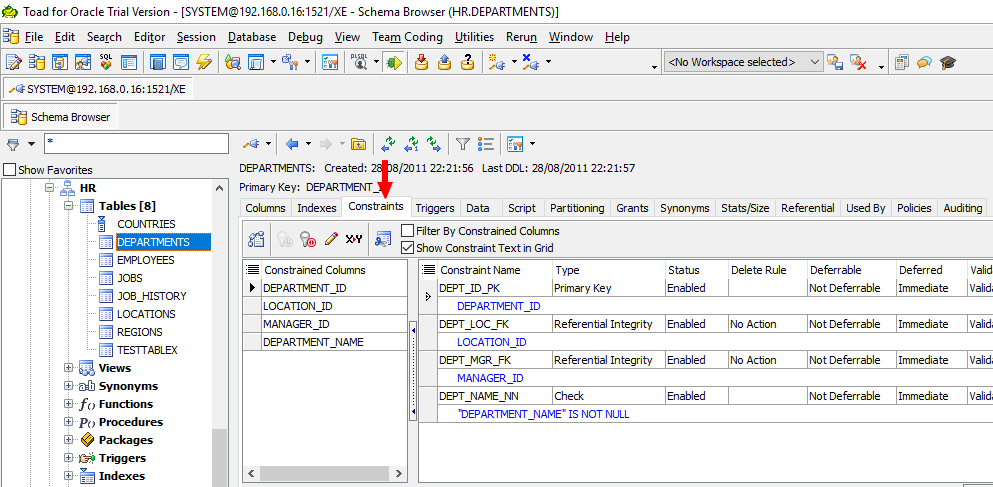
IBM DB2 Toad expert blog for developers, admins and data analysts. With solutions for Toad for Oracle, Toad for MySQL, Toad for SQL Server, DB2, SAP and more. Downloads Products Blog Forums Licenses. Toad World Blog View by Product. Toad® for Oracle Toad® for Oracle - Sensitive Data. Automatic Order. Click the appropriate column name - e.g. Click the Name column to sort attributes alphabetically. This function offers you just a different view on the attributes in the Entity Properties form. It does not influence order of attributes in entity box in the Designer. If you sort attributes this way. The referenced primary key is described in the columns rowner and rconstraintname of the table ALLCONSTRAINTS. This will give you the info you want: Just a note, the code above does not take into account Composite Foreign Keys. Refer to the answer below by @Dougman on how to account for Composite Key. Feb 26, 2014 Toad for DB2 Tips & Tricks 1. Toad™ for IBM® DB2® Tips & Tricks Become more productive with Toad 2. Want to get the most from Toad? This presentation will get you on your way to some of Toad’s most useful features. Learn how to setup and customize Toad, create and Optimize SQL statements, view and analyze result sets and more. Issue a CREATE TABLE statement and specify a FOREIGN KEY clause. Choose a constraint name for the relationship that is defined by a foreign key. If you do not choose a name, DB2® generates one from the name of the first column of the foreign key, in the same way that it generates the name of an implicitly created table space. For example, the. The implicit definition does not include any other attributes of the identified table or view. For example, the new table does not have a primary key or foreign key. The table is created in the table space implicitly or explicitly specified by the IN clause, and the table has any other optional clause only if the optional clause is specified. Guild wars 1 key generator. Db2 does not validate the data when you add the foreign key. Instead, if the table is populated (or, in the case of a nonsegmented table space, if the table space has ever been populated), the table space that contains the table is placed in CHECK-pending status, just as if it had been loaded with ENFORCE NO. Generate a key key vault in minecraft.